
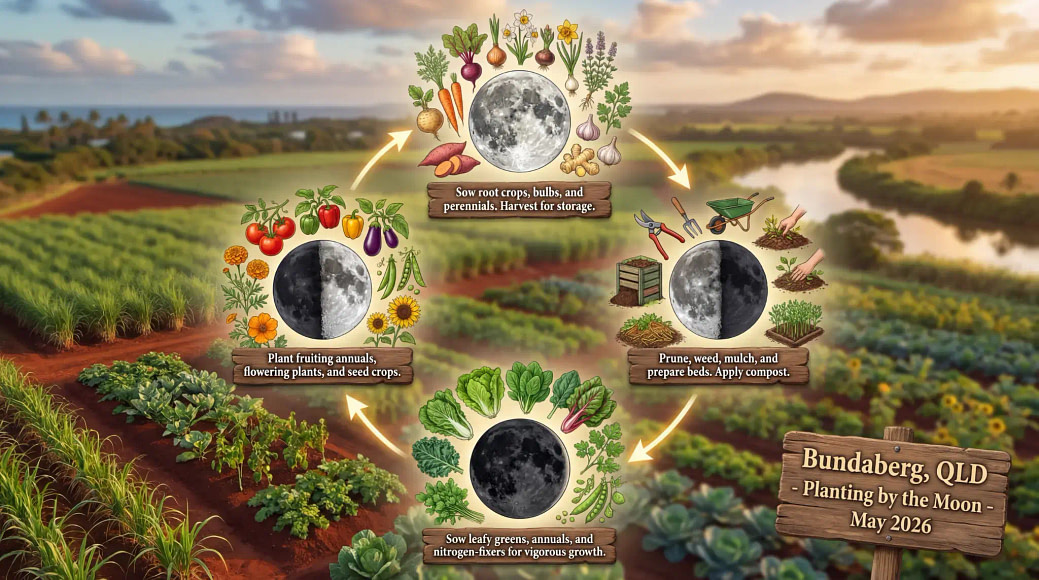
Your complete lunar planting calendar for autumn in the Bundaberg region, including a Blue Moon,
a Super New Moon, and the year's best window for brassicas.
May is the month Bundaberg gardeners wait for. The wet season is finally behind us, the fruit fly is fading, the soil is still warm enough to push seedlings along, and the cooler nights mean lettuce stops bolting and brassicas start behaving themselves. If you only get one planting month right all year, make it this one.
May 2026 also delivers a once in a calendar quirk that makes lunar gardeners pay attention. Two full moons fall inside the same month. The first arrives on Saturday 2 May and the second, a Blue Moon (and a Micro Full Moon, technically), closes out the month on Sunday 31 May. Sandwiched between them is a Super New Moon on Sunday 17 May, the closest new moon of the year. For those of us who plant by the cycle, that is a busy and unusually productive lunar calendar.
Here is everything to plant, harvest, and tend in your Bundaberg garden through May 2026, mapped to the moon.
Why Plant by the Moon
Lunar gardening is the practice of timing your sowing, transplanting, and maintenance jobs to the four phases of the moon. The thinking, refined over thousands of years across nearly every farming culture on earth, is that the same gravitational pull that lifts and drops the tides also moves moisture through soil and plant tissue. Light from the waxing moon influences seed germination and leaf growth, while the waning moon draws energy down into the roots.
Modern peer-reviewed evidence is mixed, and any honest gardener will tell you that good soil, the right variety, and consistent watering matter more than any calendar. But when you are deciding whether to direct sow your peas this Saturday or next Tuesday, the moon gives you a framework that has guided traditional growers for generations. It also forces you outside on a regular schedule, which is the real secret to a productive garden.
If you are new to lunar gardening, the BOGI library has a deeper primer, and our monthly meetings (see the activities and events page) regularly cover the topic in season.
May 2026 Moon Phases for Bundaberg
All times are local Brisbane time (AEST), which applies to Bundaberg.
Full Moon falls on Saturday 2 May at 3.23 am.
Last Quarter arrives on Sunday 10 May at 7.10 am.
New Moon (Super New Moon) occurs on Sunday 17 May at 6.01 am.
First Quarter comes on Saturday 23 May at 9.10 pm.
Second Full Moon (Blue Moon, Micro Full Moon) closes the month on Sunday 31 May at 6.45 pm.
That gives us five distinct lunar windows to work with, which is one more than most months. Here is how to use each one.
Full Moon to Last Quarter, 2 to 9 May - Roots and Bulbs
The month opens at peak lunar pull. As the full moon wanes, sap flow drops away from foliage and back into the root zone. Soil moisture, drawn upward by the full moon, settles in nicely after a couple of days, which is exactly when you want to be tucking root crops in.
What to plant in this window:
- Carrots. May is your last reliable direct-sow window before winter slows germination. Sow Nantes or Manchester Table varieties in well-worked, stone-free beds. Keep the surface damp until the seedlings are up.
- Beetroot. Bull's Blood and Detroit Dark Red both handle Bundy soils well. Sow direct, thin to 8 cm apart for full-size roots.
- Garlic. Plant cloves point up, 5 cm deep, 15 cm apart. Australian Purple, Italian Late, and Glenlarge are reliable subtropical performers and you will harvest them in October or November.
- Spring onions and shallots. Direct sow for a continuous winter supply.
- Radish. Three weeks from sowing to plate. Useful for marking out slower carrot rows.
- Swede, turnip, and parsnip. Direct sow only. Parsnip seed is notoriously slow and unreliable, so always sow fresh seed and be patient.
- Last call for sweet potato runners if you missed April. They will still strike in early May while the soil holds warmth.
Bundy tip. Our heavier red and grey clay loams can be brutal on root vegetables. Work a generous wheelbarrow of finished compost and a couple of buckets of coarse river sand into each metre of bed before sowing. Raised beds genuinely earn their keep with carrots and parsnips. If you garden on the lighter sandy soils out toward Bargara or Innes Park, focus instead on holding moisture with sugar cane mulch and a fortnightly seaweed drench.
Last Quarter to New Moon, 10 to 16 May - The Maintenance Window
The waning moon pulls energy out of foliage and into roots, and traditional planting calendars treat this period as the lowest fertility window of the cycle. Use it for everything that is not direct planting. This is the gardener's housekeeping week.
What to do in this window:
- Pull out spent summer crops. Tomatoes, capsicum, eggplant, and beans that are clearly winding down are taking up space your winter crops want.
- Prune passionfruit vines back hard. Cut the previous season's fruiting growth by a third to encourage strong spring laterals.
- Citrus prep. Apply a dolomite or gypsum dressing if your pH testing showed acidity, and side dress with composted manure. Mandarins are starting to colour up, lemons are running, and limes are still producing.
- Mulch heavily. Aim for 75 mm of sugar cane or lucerne over every bed you plan to plant. Mulch laid now insulates seedlings from the cold snaps that hit Bundaberg from late May.
- Compost turning. Heaps cooked all summer will be ready to use. Sift the finished material onto your brassica beds before the new moon.
- Pest patrol. Cabbage white butterflies are still active. Hand pick caterpillars from any seedlings already in the ground and net new plantings with fine insect mesh.
Bundy tip. The shoulder between summer and winter is when fungal pressure peaks. Powdery mildew on cucurbits, downy mildew on leafy greens, and rust on beans all bloom in the cool damp mornings. Water at the base of plants, before 9 am, never on foliage in the afternoon.
New Moon to First Quarter, 17 to 22 May - Leafy Greens and Brassicas
The Super New Moon on 17 May is the closest new moon of 2026, which means the gravitational pull is at its strongest. As the moon begins waxing, lunar light returns and energy rises through the plant. This is the gardener's sweet spot for leafy and above-ground crops, and in Bundaberg it lines up beautifully with the start of brassica season.
What to plant in this window:
- Brassicas, every one of them. Cabbage (Sugarloaf, Drumhead, Savoy), broccoli (Marathon, Green Sprouting), cauliflower (Phenomenal Early), kale (Tuscan, Red Russian), kohlrabi, collards, mustard greens, pak choy, bok choy, tatsoi, mizuna, and rocket. May plantings will mature through the cool dry months when these crops are at their best.
- Lettuce. Cos, butterhead, oak leaf, and the looseleaf mixes finally get the cool nights they want. Sow direct or transplant strong seedlings.
- Silverbeet and spinach. Both bolt in summer and thrive now. Bright Lights chard is a great choice for colour.
- Asian greens beyond brassicas. Coriander stops bolting at last, parsley powers along, and dill, chervil, and chives establish quickly.
- Strawberry runners. Strictly speaking a perennial, but May is the gold standard planting window for runners in Bundy. Plant into raised, well-drained beds heavily mulched with sugar cane.
Bundy tip. Brassicas need consistent moisture and consistent feeding. Drench fortnightly with a half-strength fish emulsion and seaweed mix from transplant onward. If your seedlings sit and sulk, the most likely cause is either compacted soil or insufficient nitrogen. A scoop of blood and bone forked into the planting hole solves both for many gardeners.
First Quarter to Second Full Moon, 23 to 30 May - Pods and Fruiting Crops
The waxing moon between the first quarter and the full moon is the traditional window for crops that produce above ground and bear fruit, pods, or seed. In May, that means peas, peas, and more peas. The cool nights of late May are exactly what peas need to set heavy pods, and Bundaberg's dry winter days mean fungal pressure stays low.
What to plant in this window:
- Garden peas. Massey, Greenfeast, and Telephone are reliable. Trellis early.
- Snow peas and sugar snap peas. Oregon Sugarpod and Sugar Snap both crop heavily in our climate.
- Broad beans. Coles Dwarf and Aquadulce. Direct sow, give them a sunny spot, and stake before they flop.
- Sweet corn, but only on a north-facing wall or warm pocket. Most of Bundaberg has run out the corn window by May, so this is for adventurous gardeners only.
- Flowering annuals. Stocks, alyssum, calendula, pansies, violas, sweet peas, snapdragons, and dianthus all establish strongly now.
- Coriander, again. Succession sow every two weeks while the cool weather holds.
Bundy tip. Pre-soak pea and broad bean seed in a glass of water with a teaspoon of seaweed solution overnight before sowing. You will see germination two to three days earlier and a more uniform strike. If you have ever bought a pea inoculant, now is the month it actually pays for itself.
Second Full Moon, Sunday 31 May - The Blue Moon
The month closes with a Blue Moon, the second full moon in a single calendar month. It is also a Micro Full Moon, meaning the moon is at its furthest point from earth in this lunation, which dampens the gravitational pull a touch compared with a normal full moon. For gardeners, treat 31 May the same way you would the start of any waning moon period. Avoid major above-ground planting on the day itself, and use the energy to harvest, finish bed preparation, and plan for June.
For lunar romantics, mark it in the diary and walk the garden at moonrise. Bundaberg under a winter Blue Moon, with the smell of new mulch and the first frost-tinged air drifting in from the cane paddocks, is one of the genuine pleasures of a year on the land.
Working With Bundaberg's May Climate
May is Bundaberg's transition into the dry season, and the numbers tell the story.
Daytime maximums average 25°C early in the month and drop toward 23°C by the final week.
Overnight minimums average 13 to 15°C in town and a couple of degrees lower out toward Childers, Gin Gin, and the Sharon district.
Rainfall averages around 70 mm for the month, mostly delivered in the first fortnight as residual coastal showers.
Humidity drops from around 65 per cent to around 55 per cent.
Daylight shrinks from 10 hours 55 minutes to 10 hours 36 minutes as we approach the winter solstice in June.
Frost risk in central Bundaberg is effectively zero in May, but properties on the elevated ranges around Childers can record their first light frost in the final week. If you garden at altitude, check overnight forecasts after 25 May and have frost cloth on standby for tender seedlings.
Soil temperature is the metric that matters most for May plantings. By the end of the month soil temps in raised beds drop below 18°C, which is the floor for reliable bean and corn germination, and approaches the limit for capsicum and tomato strikes. Use a $20 soil thermometer rather than guessing, and prioritise warm beds (north-facing, well-mulched, raised) for any borderline crops.
What to Harvest in May
May is one of the most generous harvest months in Bundaberg.
Tomatoes (the last of the summer crop), capsicum and chilli, eggplant, sweet potato, pumpkin, butternut and other squash, sweet corn, late beans, okra, basil, mandarins (Imperials and Hickson), early oranges, lemons, limes, ginger, turmeric, pawpaw, custard apple, dragon fruit, late passionfruit, and persimmons.
If your sweet potato vines have died back, the tubers are ready. Lift carefully with a fork. Cure them in a warm, ventilated spot for ten days before storing.
A Note on Lunar Gardening
Planting by the moon is not magic, and it is not a replacement for sound horticultural fundamentals. Soil tests, variety selection, moisture management, and pest monitoring will always do more for your yields than any calendar. What lunar gardening offers is a rhythm. It pulls you outside on a regular cadence, structures your week, and lines up your planting decisions with the oldest agricultural calendar humans have ever used.
Try it for one season. Plant your brassicas at the new moon and your peas at the first quarter, and see whether it makes a difference in your patch. Most Bundaberg members of BOGI will tell you it does, and the ones who are not convinced will at least concede that the schedule kept them gardening on the days they would otherwise have skipped.
Quick Reference, May 2026
2 to 9 May (waning after Full Moon). Plant root crops, garlic, and sweet potato runners. Harvest carrots and beetroot ahead of cold.
10 to 16 May (Last Quarter to New Moon). Maintenance week. Pull spent summer crops, mulch heavily, prune passionfruit, prep brassica beds.
17 to 22 May (waxing after Super New Moon). Plant brassicas, leafy greens, herbs, and strawberry runners. Best leafy planting window of the year.
23 to 30 May (First Quarter to Full Moon). Plant peas, broad beans, and flowering annuals. Direct sow.
31 May (Blue Moon). Harvest, finish bed prep, and rest.
Looking Ahead to June
June brings Bundaberg's coolest mornings, the year's shortest days, and the start of citrus glut. It is the prime planting window for onions, leeks, garlic (if you missed May), more peas, broad beans, broccoli, and the second wave of lettuce and spinach. The new moon falls on Monday 15 June and the full moon on Tuesday 30 June, which is also a Micro Full Moon.
Start preparing your June beds now. Fork in compost, check pH, and order any seed you need before stocks run thin. Our June planting guide will be live by the first of the month.
Frequently Asked Questions
Does the moon really affect plant growth?
The gravitational pull of the moon does measurably affect groundwater and soil moisture, and lunar light influences germination rates in some species. Whether the effect is large enough to change yields is contested in the scientific literature. Lunar planting is best treated as a useful schedule that aligns with traditional knowledge, rather than a guaranteed yield boost.
What is the best vegetable to plant in May in Bundaberg?
Brassicas top the list. Cabbage, broccoli, cauliflower, kale, and Asian greens all thrive in our cool dry autumn and run through into winter. Peas are the close runner-up. Both crops respond well to a May sowing because Bundaberg nights are cooling but the soil is still warm enough for fast germination.
When should I plant garlic in Bundaberg?
Late April through May is ideal. The bulbs need a cool period to form properly, and Bundaberg's mild winters mean you have to plant early enough to get that exposure. Australian Purple, Italian Late, and Glenlarge are the standout subtropical varieties.
What is a Blue Moon, and does it matter for gardening?
A Blue Moon is the second full moon in a single calendar month. It happens roughly once every two and a half years. From a lunar gardening perspective, treat it the same as any other full moon. The day of the full moon is best for harvesting and bed maintenance, not for active planting.
Where do you source the moon phase data?
All times are in local Brisbane time (AEST), sourced from timeanddate.com, the closest reference city to Bundaberg.
Bundaberg Organic Gardeners Inc has been growing organic food in the Wide Bay since 1991. If you found this guide useful, join us to get monthly meetings, members-only resources, and access to our seed bank. Our next workshop and field day dates are on the activities and events page.
Moon phase data sourced from timeanddate.com for Brisbane, Queensland (the nearest reference city to Bundaberg).