
Planting by the Moon, September 2026 - A Bundaberg Gardener's Guide
Your complete lunar planting calendar for the start of Bundaberg's spring planting wave, including the spring equinox, four moon phases, and the full warm-season vegetable list opening up.
September is the busiest planting month of the Bundaberg gardening year. The dry season is ending, the spring equinox brings days that match nights for the first time since March, and the soil thermometer holds steady above 20°C in raised beds. Every warm-season crop you have been waiting for can finally go in, and the choices that get made in September shape your kitchen table from November through to March.
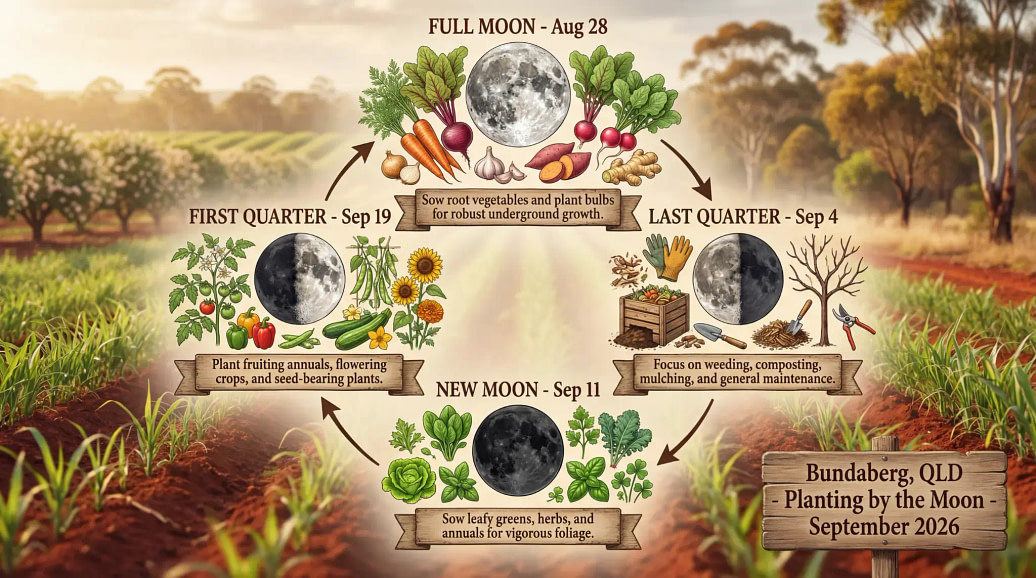
For lunar gardeners, September 2026 is a clean four-phase month with the spring equinox falling on Tuesday 22 September, five days before the full moon. The new moon on Friday 11 September at 1.26 pm sets up a strong leafy and herb planting window. The first quarter on Saturday 19 September launches the prime fruiting wave that runs through the equinox into late September. The full moon on Sunday 27 September closes the month with a harvest and storage focus.
If you only have one weekend a month to garden, make it the weekend after 19 September.
Why Plant by the Moon
Lunar gardening is the practice of timing seed sowing, transplanting, and bed maintenance to the four phases of the moon. Traditional growers across every farming culture observed that the same gravitational forces moving the tides also influence soil moisture and sap flow inside plants. The waxing moon, from new to full, suits crops grown for above-ground harvest. The waning moon, from full to new, suits root crops, harvest, and maintenance.
The science is mixed on how strong these effects are at the scale of a backyard vegetable bed, but the schedule has guided productive growers for centuries. In September, when the spring planting list runs to a full page and you can easily get the timing wrong, having a moon-based calendar is a useful way to pace the work and avoid planting your beans the same weekend as your tomatoes.
If you are new to the practice, the BOGI library has further reading, and our activities and events page lists upcoming workshops where members share their results.
September 2026 Moon Phases for Bundaberg
All times are local Brisbane time (AEST), which applies to Bundaberg.
Last Quarter on Friday 4 September at 5.51 pm.
New Moon on Friday 11 September at 1.26 pm.
First Quarter on Saturday 19 September at 6.43 am.
Full Moon on Sunday 27 September at 2.49 am.
Spring equinox falls on Tuesday 22 September at 12.06 pm AEST, day and night equal across the southern hemisphere.
The month opens in a waning phase carrying through from the late August full moon, which means the first three days are naturally suited to root crops and bed preparation rather than fresh top growth.
1 to 3 September - Late Waning Gibbous
The first three days of September sit in the late waning gibbous, with energy moving downward into the root zone. A short window for direct-sown root crops before the maintenance week begins.
What to plant in this window:
- Beetroot. Detroit Dark Red, Bull's Blood, Chioggia. Direct sow only.
- Carrots. Manchester Table, Topweight, Nantes. Cover the row with hessian until germination.
- Radish. Three weeks from sowing to plate.
- Salad onions and shallots. Continuous succession.
- Sweet potato slips. Plant into warm, well-drained, mulched beds. The soil is now consistently warm enough.
Bundy tip. The combination of warming days and still-cool nights in early September is perfect for beetroot germination. If you have struggled with beetroot in past seasons, the early September window is your best bet for a clean strike. Soak the seed cluster in water overnight before sowing for faster, more uniform germination.
4 to 10 September - Last Quarter to New Moon, the Maintenance Week
The waning crescent is the lowest fertility window of the lunar cycle. Use this week for the jobs that prepare the garden for the September planting wave. Everything you do in this window pays off through the next three months.
What to do in this window:
- Bed preparation. Fork over fallow beds, work in 5 to 10 cm of finished compost, add aged manure, and apply a complete organic fertiliser at the recommended rate. Water in deeply and let the soil rest until the new moon.
- Pest preparation. The first fruit fly of the season appears in early September. Hang traps now (not after you see damage) and prepare exclusion netting for tomatoes, capsicum, eggplant, and stone fruit. Cabbage white butterflies are still around, finishing off late brassicas.
- Trellis installation. Build or repair pea, bean, cucumber, tomato, and passionfruit trellises now while the weather is comfortable.
- Mulch. Pull old mulch back to let the sun warm the soil, then top up with fresh sugar cane or lucerne after planting.
- Compost turning. The summer heaps you started in autumn are now finished. Sift the compost onto your spring beds.
- Citrus. Apply a complete organic fertiliser around the drip line, water deeply, and prune lightly to shape any awkward growth. The new flush of leaves is starting.
Bundy tip. The week before the spring planting wave is the right time to test your irrigation system. Check every drip line for blockages, every sprinkler for coverage, and every timer for correct programming. Once you have ten beds full of seedlings demanding daily water, problems with the system cost you crops fast.
11 to 18 September - New Moon to First Quarter, the Leafy and Herb Window
The new moon on 11 September launches the next waxing cycle. As lunar light returns and energy rises through plants, this is the prime window for leafy greens, herbs, and the spring vegetables that grow above ground but are not heavy fruiters.
What to plant in this window:
- Lettuce (heat-tolerant varieties). Salinas, Mignonette, Cos types, oak leaf, and the loose-leaf summer mixes. Switch from cool-season varieties.
- Asian greens (last reliable window). Pak choy, bok choy, tatsoi, mizuna, mustards, and rocket can still crop quickly before the first heat hits.
- Silverbeet and chard. Both will run into early summer.
- Coriander, parsley, dill, chervil, and chives.
- Basil. Sweet basil, Genovese, Thai, lemon basil, and Greek bush basil. The standout spring herb.
- Spring herb seedlings. Oregano, sage, thyme, marjoram, lemon balm, lemongrass, and Vietnamese mint.
- Nasturtiums and marigolds. Both companion plant and crop.
- Sunflowers and zinnias. Plant in blocks for cut flowers and beneficial insect support.
- Spring onions and chives. Continuous succession.
Bundy tip. Basil planted at the new moon and watered with a half-strength seaweed drench at planting will outperform basil planted in mid-October by a large margin. The cooler nights in early September help the plant develop a strong root system before the summer heat arrives, which translates to bigger leaves and a longer cropping season before flowering.
19 to 26 September - First Quarter to Full Moon, the Spring Fruiting Window
The waxing moon between the first quarter and the full moon, running across the spring equinox, is the prime fruiting planting window of the year. Soil temperatures are reliably above 20°C, days and nights are balanced, and the warm-season crop list is fully open.
What to plant in this window:
- Tomatoes (full range). Disease-resistant cultivars perform best in our climate. Tommy Toe, Mighty Red, Black Cherry, Tigerella, Roma, San Marzano, Grosse Lisse, KY1, Mortgage Lifter, and the cherry types. Stake or cage at planting, mulch immediately, and start a fortnightly succession plan. The BOGI shop carries the full warm-season seed range and seedlings through September.
- Capsicum and chilli. California Wonder, Yolo Wonder, Sweet Banana, Cayenne, Habanero, Birds Eye, and Jalapeno. Plant in a sheltered, sunny position and water deeply.
- Eggplant. Black Beauty, Long Purple, Lebanese, and the Asian Green and White varieties.
- Beans, climbing and bush. Lazy Housewife, Purple King, Blue Lake, Rattlesnake. Direct sow only. Pre-soak seed for an hour for faster germination.
- Snake beans. The early end of the window. Wait until late September or October if your soil is still cool.
- Cucumbers. Lebanese, Marketmore, Sweet Slice. Direct sow into warm soil.
- Zucchini and squash. Black Jack, Cocozelle, Yellow Crookneck. One plant feeds a household.
- Sweet corn. Honey Sweet, Snow Gold. Direct sow in blocks of at least 16 plants for proper pollination.
- Pumpkin, butternut, watermelon, rockmelon. Direct sow into hills enriched with compost. The full warm-season window opens.
- Sweet potato slips. Continue planting through the window.
- Sunflowers, cosmos, marigolds. Spring colour and pollinator support.
Bundy tip. September fruit fly pressure builds fast. The day you transplant your tomatoes is the day you should also hang at least one fruit fly trap per ten metres of garden, and have exclusion netting ready to drape over fruiting plants from first flower. Waiting until you see stings is too late.
Full Moon, Sunday 27 September - Harvest and Plan
The full moon at the end of September is a textbook full moon. Use the day to harvest crops you intend to store, finalise October bed preparation, and walk the garden to assess how the spring plantings are establishing. Traditional lunar wisdom says to avoid major above-ground sowing on the day of the full moon.
This is also a good day for the September seed save. Coriander, dill, parsley, and last winter's brassicas that have run to flower are starting to set seed. Bag the heads, hang to dry, and label clearly.
Working With Bundaberg's September Climate
September is a warming month with notable variation between the start and end.
Daytime maximums average 25°C in the first week, climbing to 27°C by the final week.
Overnight minimums average 14 to 16°C in town, with cooler readings at altitude.
Rainfall averages around 35 mm for the month, with most of it delivered as light coastal showers rather than the heavy summer downpours.
Humidity sits around 55 to 60 per cent.
Daylight grows from 11 hours 31 minutes at the start of the month to 12 hours 7 minutes by 30 September. The spring equinox on 22 September delivers exactly 12 hours of daylight.
Frost is finished for the season across all of Bundaberg by the start of September.
Soil temperature in raised beds rises from around 19°C at the start of the month to 22°C by the final week. The full warm-season planting list is open from 11 September onward in raised beds and from 19 September onward in cooler ground.
What to Harvest in September
September is the bridge harvest month, with winter crops finishing and spring crops not yet producing.
Late navel and valencia oranges, lemons, limes, grapefruit, the last of the broccoli and cauliflower, late cabbage, kale, kohlrabi, pak choy, bok choy, lettuce, silverbeet, spinach, peas (last), broad beans (last), beetroot, carrots, salad onions, herbs, strawberries (peak), the first of the new season pawpaw, mulberries (early), and asparagus from established crowns.
Strawberries reach their peak in September and into October. Pick daily, mulch heavily underneath to keep the fruit clean, and net to keep the birds out.
A Note on Lunar Gardening
Planting by the moon is older than written records. The schedule survives because it works often enough that traditional growers kept using it for centuries. The mechanism is small but measurable. Soil moisture rises and falls with lunar gravity, lunar light affects germination and shoot growth, and timing your work to the cycle aligns your effort with what the plants are already responding to.
In September, when the planting list is at its longest and the temptation is to plant everything in one weekend, the lunar calendar gives you a reason to pace the work. Plant your leafy crops the week of the new moon. Plant your fruiting crops the week of the first quarter. Use the maintenance week before the new moon for bed preparation. The schedule writes itself.
Quick Reference, September 2026
- 1 to 3 September (late waning gibbous). Plant root crops and sweet potato slips.
- 4 to 10 September (last quarter to new moon). Maintenance week. Bed prep, fruit fly traps, trellis building, irrigation check.
- 11 to 18 September (new moon to first quarter). Plant lettuce, basil, herbs, last Asian greens.
- 19 to 26 September (first quarter to full moon). The big spring wave. Tomatoes, capsicum, chilli, beans, sweet corn, cucurbits, sweet potato.
- 27 September (full moon). Harvest, plan, save seed.
Looking Ahead to October
October sees Bundaberg shift into early summer mode. The new moon falls on Sunday 11 October and the full moon on Monday 26 October. Tropical and heat-tolerant crops can go in alongside the continuing succession of tomatoes and beans, and the first of the wet season storms typically arrive in the second half of the month.
Order seed for snake beans, okra, rosella, and ginger if you plan to plant heat-tolerant tropicals. Plan succession sowings of beans, sweet corn, and cucumber. Our October planting guide will be live by 1 October.
Frequently Asked Questions
What is the biggest planting month for vegetables in Bundaberg?
September is the most productive single planting month of the Bundaberg year. The full warm-season list opens up, soil temperatures are reliably above 20°C, and the spring equinox brings balanced day length. Plantings made between 19 and 26 September will crop through summer.
When should I start fruit fly control in Bundaberg?
The first fruit flies of the season appear in early September. Hang traps before you transplant susceptible crops, not after. Exclusion netting goes on at first flower. Combined trap-and-net management gives you the best chance of clean fruit through the season.
Is it too late to plant brassicas in September?
Mid-September is too late for broccoli, cauliflower, cabbage, and kale in Bundaberg. They will not head before the October heat arrives. Asian greens like pak choy, bok choy, and rocket can still crop in early September because they mature quickly, but switch to summer leafy crops from the new moon onward.
When is the spring equinox in Bundaberg in 2026?
The spring equinox falls on Tuesday 22 September 2026 at 12.06 pm AEST. Day and night are equal at exactly 12 hours each, and from this date forward days are longer than nights through to the autumn equinox in March.
Where do you source the moon phase data?
All times are local Brisbane time (AEST), sourced from timeanddate.com, which is the closest reference city for Bundaberg.
Bundaberg Organic Gardeners Inc has been growing organic food in the Wide Bay since 1991. If you found this guide useful, join us to get monthly meetings, members-only resources, and access to our seed bank, and browse our shop for seasonal seeds, mulch, and member resources. Our next workshop and field day dates are on the activities and events page.
Moon phase data sourced from timeanddate.com for Brisbane, Queensland (the nearest reference city to Bundaberg).