
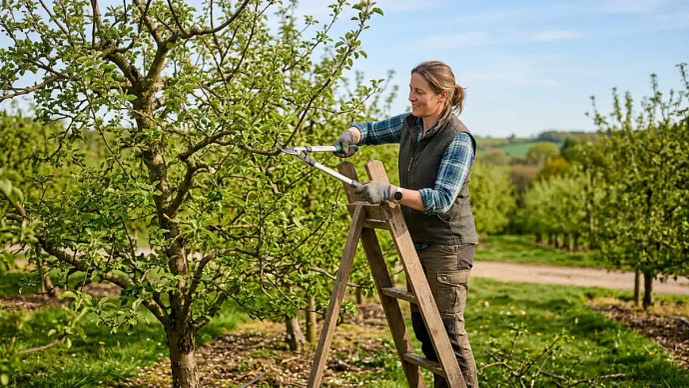
Keeping Trees Healthy, Productive and Manageable
Pruning fruit trees is not simply about cutting off branches. It is about managing the size, shape and structure of the tree so that it remains healthy, productive and easy to care for.
One of the key messages from the pruning demonstration was: don’t allow home fruit trees to become excessively large. Smaller, well-structured trees are easier and safer to prune and harvest, allow better observation
of pests and diseases, and reduce the need for ladders.
Start by looking at the whole tree
Before making a cut, walk around the entire tree. Rather than standing in one position and cutting whatever is in front of you, consider the overall structure. Look for branches that are crossing or rubbing, areas where light and air need to enter, and branches that will improve access to the fruit.
Branches that rub against each other should be removed where appropriate. Constant rubbing can damage the bark and create wounds that may provide opportunities for disease.
If a tree has become too tall, reduce its height gradually rather than removing a large amount in one year.
Select the tallest unwanted branch and cut it back to a suitable junction. Continue reducing the height over subsequent years, as excessive pruning can place the tree under considerable stress.
Create an open, productive tree
Fruit trees generally benefit from an open canopy that allows light and air to circulate. This creates better conditions for fruit development and allows productive growth to develop within the canopy.
For some fruit trees, Marlene recommends establishing just three or four major main branches. Having too many major branches can result in the tree putting energy into excessive growth rather than productive fruiting branches.
Very vigorous, upright shoots are referred to as “male” growth in their teaching terminology. These shoots can grow rapidly, dominate the tree and, in some cases, develop thorns. They should be selectively removed or managed so that they do not take resources away from productive branches.
Different trees need different approaches
Lychees:
A large opening or “volcano” can be created in the canopy, preferably opening towards the side where the sun rises. Small cuts alone may allow the canopy to quickly close again.
Macadamias:
A similar large opening can be created. Rather than removing many branches at once, remove one major branch and then allow the tree several years to respond before repeating the process. Mistletoe is also a significant problem for macadamias in the Bundaberg area and should be monitored.
Citrus:
Citrus can tolerate fairly firm pruning. Aim for around three or four main branches, opening the structure and removing branches that interfere with access. Regular, annual pruning helps keep citrus trees manageable.
Mulberries:
Mulberries can be cut back quite low. As new fruiting branches develop, they can be bent down and tied. This makes fruit much easier to pick and protect from birds, while reducing the need for ladders. The same principle of bending branches down can also be used with peach and plum trees.
Mangoes:
Mango trees also benefit from careful pruning. However, as with all fruit trees, pruning should be guided by the tree's growth habit and the goal of maintaining a manageable, productive canopy.