
Reviving Struggling Macadamia Trees with Biology and Balanced Nutrition
A remarkable transformation in just 112 days
Healthy plants begin with healthy soil. While we often focus on watering and fertilising, this trial demonstrates that rebuilding soil biology and supplying a balanced range of minerals can dramatically improve plant growth—even in poor, compacted soils.
A small trial involving endangered Macadamia jansenii trees provides an excellent example of what can happen when the soil ecosystem is restored.
Background
In April 2020, eleven young Macadamia jansenii trees were planted in the Botanical Gardens. Unlike the commercial macadamia varieties grown for nuts, Macadamia jansenii is a rare native species. These trees were planted to help preserve valuable genetic diversity for future generations.
The young trees were established using accepted horticultural practices. They were transplanted, irrigated and mulched with woodchips before receiving the same ongoing care as the rest of the gardens.
Unfortunately, after more than a year, the results were disappointing.
By May 2021:
- Two trees had already died.
- The remaining nine were struggling to survive.
- Growth was minimal.
- Leaves showed chlorosis (yellowing), indicating nutrient deficiencies.
- Wind exposure and difficult soil conditions were limiting establishment.
The site presented significant challenges. Very little topsoil remained, leaving the trees growing in dense, compacted silty loam subsoil. The soil had virtually no crumb structure and showed almost no signs of biological activity.
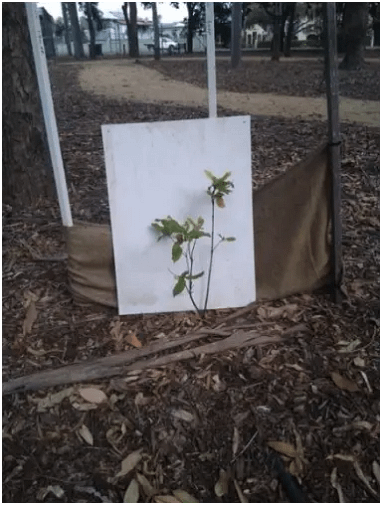
Control tree 1
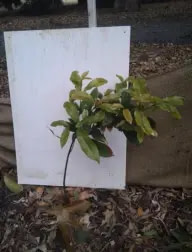
Control tree 2
The Trial
On 10 May 2021, two of the surviving trees received a biological soil treatment designed to restore both nutrition and microbial life.
Each tree received:
- Bio-Booster – 1 litre
- Fine agricultural lime (calcium) – 10 g
- Zinc sulphate heptahydrate – 10 g
- Humic acid – 10 ml
- Liquid Sea Minerals – 10 ml
The mixture was applied in water approximately half a metre from the trunk to encourage root development throughout the surrounding soil.
The remaining seven trees were left untreated for comparison.
Results After 112 Days
When the trees were inspected on 30 August 2021, the difference was extraordinary.
During the same period:
- Three more untreated trees had died.
- The remaining untreated trees continued to struggle with poor growth and unhealthy foliage.
The treated trees, however, told a completely different story.
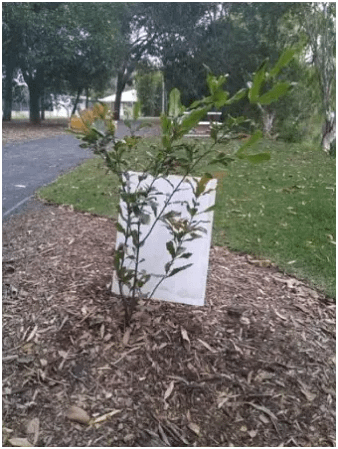
Control tree 1 showing improved growth
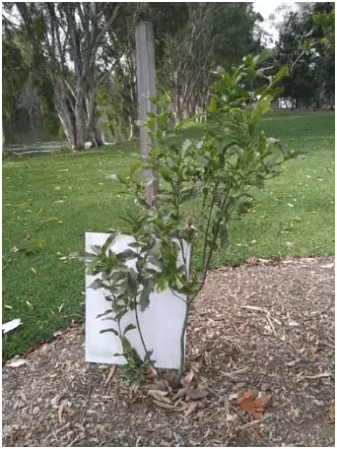
Control tree 2 showing improved growth
Visible improvements included:
- Growth increased by two to four times.
- Healthy, dark green foliage replaced the yellowing leaves.
- New shoots developed rapidly.
- Strong root growth was evident.
- The previously lifeless soil had begun forming a crumb structure.
Perhaps the most significant observation was beneath the surface.
The compact subsoil had begun to soften and develop stable aggregates—a clear indication that soil microorganisms had become active and were rebuilding the soil structure. Increased root development further confirmed that the underground ecosystem was recovering.
One tree, which had remained stunted at approximately knee height for more than thirteen months, produced almost one metre of new growth in just 112 days.
Why Did It Work?
Plants require much more than nitrogen, phosphorus and potassium to thrive.
Healthy growth depends upon three essential components working together:
- Balanced mineral nutrition
- Active soil biology
- Organic matter that feeds soil microorganisms
In this trial, the added minerals corrected nutrient deficiencies, while the Bio-Booster and humic acid stimulated microbial activity. As beneficial microorganisms multiplied, they improved soil structure, increased nutrient availability and created a healthier environment for root growth.
Once the biology became active, the trees were able to access nutrients and moisture far more effectively.
Lessons for Gardeners
Many gardens contain soils that have become compacted, depleted or biologically inactive through years of cultivation, construction or chemical use.
This trial demonstrates that restoring soil life can often be more important than simply adding more fertiliser.
Gardeners can encourage healthier plants by:
- Feeding the soil, not just the plant.
- Providing a broad spectrum of essential minerals.
- Applying composts, humates and biological inoculants where soil life is lacking.
- Avoiding practices that destroy soil organisms.
- Maintaining mulch to protect and nourish the soil ecosystem.
Healthy soil biology creates better soil structure, improves water infiltration, releases nutrients naturally and builds resilient plants that are better able to resist pests, diseases and environmental stress.
Nature Responds Quickly
Perhaps the most inspiring aspect of this trial is the speed of recovery.
After more than a year of virtually no growth, the treated trees transformed in less than four months.
The results remind us that Nature has an extraordinary ability to repair itself when given the right conditions. By restoring the living biology beneath our feet and supplying balanced nutrition, even severely degraded soils can once again support vigorous, healthy plant growth.
Sometimes the greatest improvements happen not because we feed the plant more, but because we bring the soil back to life.
View the original article here.