
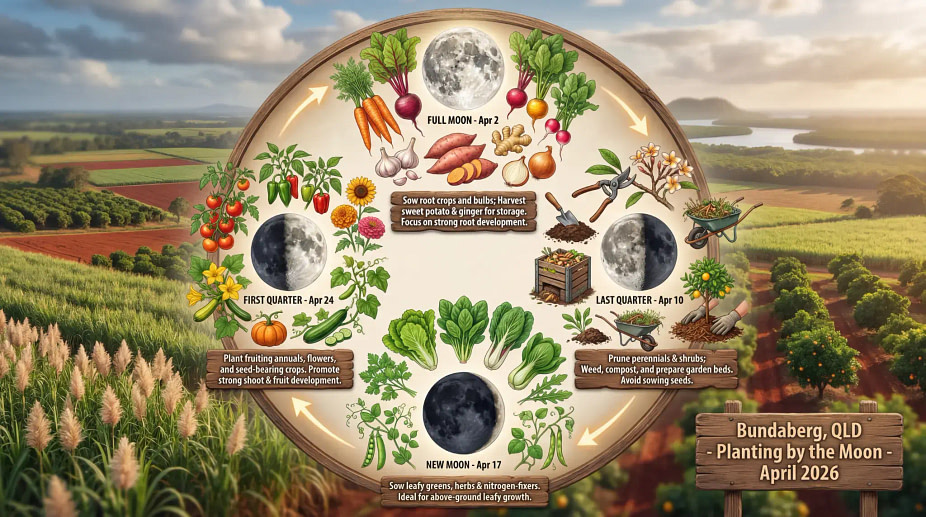
Planting by the Moon, April 2026 - A Bundaberg Gardener's Guide
Your complete lunar planting calendar for the heart of Bundaberg's autumn, with the brassica transplant window in full swing, the year's prime peas and broad beans timing, and the start of the dry season after a long wet summer.
April is when Bundaberg gardening hits its rhythm. The wet season is finally finished, the cyclone watch is officially closed, the humidity drops to genuinely comfortable levels, and the cool nights stop the bolting and pest pressure that flattened summer crops. By mid-month the brassica transplants are establishing strongly, the peas and broad beans are climbing, and the autumn leafy wave is at peak production.
It is also the most pleasant month of the year to spend in the garden. The mornings are crisp, the days hover around 27°C, the afternoon storms are over, and you can work straight through from breakfast to dinner without baking. If you only get one productive month a year in the garden, April is the easy candidate.
For lunar gardeners, April 2026 is a clean four-phase month. The full moon on Thursday 2 April at 12.11 pm sits in the daytime sky, with the moon rising visible just before sunset. The new moon on Friday 17 April at 9.51 pm sets up the prime autumn leafy planting window. The first quarter on Friday 24 April launches the second wave of brassica transplants and the first heavy pea plantings.
Why Plant by the Moon
Lunar gardening is the practice of timing seed sowing, transplanting, and bed maintenance to the four phases of the moon. Traditional growers across every farming culture observed that the same gravitational forces moving the tides also influence soil moisture and sap flow inside plants, and that lunar light affects germination and shoot growth. The waxing moon, from new to full, suits crops grown for above-ground harvest. The waning moon, from full to new, suits root crops, harvest, and maintenance.
The science is mixed on the magnitude of the effect, but the schedule has guided productive growers for centuries. In April, with the autumn planting list at its longest and the workload manageable, the lunar calendar gives you a way to pace the work so that the autumn beds establish in waves rather than all at once.
If you are new to the practice, the BOGI library has further reading, and our activities and events page lists upcoming workshops where members compare their results.
April 2026 Moon Phases for Bundaberg
All times are local Brisbane time (AEST), which applies to Bundaberg.
Full Moon on Thursday 2 April at 12.11 pm.
Last Quarter on Friday 10 April at 2.51 pm.
New Moon on Friday 17 April at 9.51 pm.
First Quarter on Friday 24 April at 12.31 pm.
The month opens at a Full Moon, which means the first nine days are naturally suited to harvest, root crops, and maintenance rather than fresh top growth.
1 to 9 April - Full Moon to Last Quarter, Roots and Brassica Transplants
The first nine days of April sit in the waning gibbous and waning quarter, with energy moving downward into the root zone. This is also a strong window for transplanting brassica seedlings raised in March, because the developing root systems benefit from the gravitational pull on soil moisture.
What to plant in this window:
Brassica transplants, full range. Cabbage (Sugarloaf, Drumhead, Savoy), broccoli (Marathon, Green Sprouting Calabrese), cauliflower (Phenomenal Early, Snowball), kale (Tuscan, Red Russian, Curly), kohlrabi (Purple Vienna, White Vienna), Brussels sprouts, collards, mustards. April plantings will mature through cool dry winter conditions when these crops are at their best. The BOGI shop is a reliable local source for brassica seedlings and seed during the autumn rush.
Beetroot. Detroit Dark Red, Bull's Blood, Chioggia. Direct sow only.
Carrots. Manchester Table, Topweight, Nantes. Cover the row with hessian until germination.
Radish, parsnip, swede, turnip. All direct sow.
Salad onions and shallots. Continuous succession.
Onion seedlings (early plantings). Hunter River Brown, Gladalan Brown, Spring Onion White Lisbon. Transplant strong seedlings into prepared beds.
Strawberry runners. Albion, Camarosa, Sweetheart. The full April window is open.
Bundy tip. Brassica transplants are vulnerable in their first fortnight. Drape insect netting over the bed immediately after planting, even if you have not yet seen a cabbage white butterfly. The first egg-laying flush usually arrives in early to mid-April, and prevention is much cheaper than the daily caterpillar hunt that follows.
10 to 16 April - Last Quarter to New Moon, the Maintenance Week
The waning crescent is the lowest fertility window of the lunar cycle. Use this week for the autumn maintenance jobs that keep the brassica wave establishing strongly and prepare beds for the next plantings.
What to do in this window:
Bed preparation. Pull any spent summer crops, fork over fallow beds, work in 5 to 10 cm of finished compost, add aged manure, and apply a complete organic fertiliser ahead of the new moon.
Mulch every bed. Sugar cane mulch at 75 mm. Bare soil now will dry out fast as the dry season establishes.
Pest patrol. Cabbage white butterflies are at peak laying. Check brassicas daily, hand pick caterpillars, apply Dipel if pressure is heavy, and ensure netting is intact.
Aphid management. The first aphid colonies appear on brassica seedlings. Squash colonies by hand, hose off heavier infestations early in the morning, or apply a half-strength soap and water solution.
Fruit fly tail. The last fruit fly pressure of the season is in early to mid-April. Re-bait traps. The pressure will fade fast through the second half of April.
Citrus prep. Mandarins are starting to colour. Apply a complete organic fertiliser around the drip line, water deeply, and watch for the first ripe fruit.
Compost. Heaps started in summer are ready. Sift the compost onto your autumn beds.
Seed organisation. Inventory your seed packets, check viability dates, and order any winter seed you still need. Garlic, onion, and leek seed needs to be in by late April.
Bundy tip. The maintenance week is the right time to side-dress your established brassicas with a complete organic fertiliser. A handful of pelletised manure or compost worked into the soil around (not against) each plant gives them the nitrogen kick they need to power into the cool weather. Repeat at the four-week mark for the strongest crops.
17 to 23 April - New Moon to First Quarter, the Autumn Leafy Wave
The new moon on 17 April launches the next waxing cycle. As lunar light returns and energy rises through plants, this is the prime window for the autumn leafy wave. Cool-season vegetables come into their own here.
What to plant in this window:
Lettuce, full range. Cos, butterhead, oak leaf, mignonette, and the loose-leaf mixes. Direct sow or transplant seedlings.
Asian greens, full range. Pak choy, bok choy, tatsoi, mizuna, mustards, rocket, Chinese cabbage, choy sum.
Silverbeet and chard. Bright Lights chard adds colour to a winter plate.
Spinach. The cool nights stop the bolting that ruined summer plantings.
Coriander, parsley, dill, chervil, chives. Cool-season herbs at their best.
Spring onions, salad onions, and chives. Continuous succession.
Brassica seedlings (transplant from new moon onward). Continue the brassica wave with broccoli, cauliflower, cabbage, and kale. Stagger plantings every two to three weeks for continuous harvest.
Sweet peas, calendula, stocks, pansies, violas, and snapdragons. Autumn colour into winter.
Bundy tip. The new moon planting window in late April is the most productive autumn leafy wave of the year. The combination of cool nights, easing humidity, and moist autumn soil produces faster, cleaner germination than any other autumn week. Plant your full leafy range this week and you will be picking salad in four to five weeks.
24 to 30 April - First Quarter to Full Moon, Peas and Broad Beans
The waxing moon between the first quarter and the full moon is the prime fruiting and pod planting window. Late April is the textbook peas and broad beans planting window for Bundaberg. The cool nights of early winter are exactly what these crops need to set heavy pods, and the dry weather keeps fungal pressure low.
What to plant in this window:
Garden peas. Massey, Greenfeast, Telephone. Trellis early.
Snow peas and sugar snap peas. Oregon Sugarpod and Sugar Snap. Pick young and often.
Broad beans. Coles Dwarf and Aquadulce. Direct sow only. Stake before they flop.
Garlic (early plantings). The full window opens for May planting, but late April plantings work for warmer beds. Australian Purple, Italian Late, Glenlarge.
Onion and leek seedlings. Continuing the planting window. Transplant strong seedlings into prepared beds.
Brassica seedlings (continuing). Stagger plantings every two to three weeks.
Strawberry runners (continuing).
Beetroot, carrots, radish (continuing).
Flowering annuals. Stocks, calendula, alyssum, sweet peas, dianthus.
Bundy tip. Pre-soak pea and broad bean seed in a glass of water with a teaspoon of seaweed solution overnight before sowing. You will see germination two to three days earlier and a more uniform strike. If you have a pea inoculant, late April is when it pays for itself.
Working With Bundaberg's April Climate
April is the autumn shoulder month, with notable variation between the start and end.
Daytime maximums average 28°C in the first week, dropping to 25°C by the final week.
Overnight minimums average 18 to 20°C in the first week, dropping to 15 to 17°C by 30 April.
Rainfall averages around 80 mm for the month, almost all delivered in the first half. The dry season is establishing through the second half of April.
Humidity drops from around 70 per cent at the start of the month to 60 per cent by 30 April.
Daylight shrinks from 11 hours 58 minutes at the start of the month to 11 hours 16 minutes by 30 April.
Soil temperature in raised beds drops from around 22°C at the start of the month to 19°C by the final week. The full cool-season planting list is open.
Cyclone risk is essentially over by the start of April. The dry season is establishing.
What to Harvest in April
April is one of the most varied harvest months of the year, with summer crops finishing, autumn crops in production, and the first citrus colouring up.
Sweet potato (peak harvest from spring plantings), late pumpkin, the first new season pumpkin, the last beans, late capsicum and chilli, late eggplant, the last summer tomatoes, basil (final harvest before cool weather), pineapple, pawpaw, dragon fruit, passionfruit, custard apple, banana, the last late mangoes (Keitt), early mandarins (Imperial), the very first ripe lemons and limes, late avocado (Reed, Lamb Hass), Asian greens from late February sowings, the first lettuce from March plantings, early autumn beetroot and carrots, herbs, salad onions, and the first early brassica leaves.
If your sweet potato vines have died back, the tubers are ready. Lift carefully with a fork. Cure them in a warm, ventilated spot for ten days before storing. Properly cured sweet potato keeps for three to four months in a cool, dark, dry pantry.
A Note on Lunar Gardening
Planting by the moon survived because it works often enough that traditional growers kept using it for centuries. The mechanism is real but small. Gravity moves water, lunar light affects germination, and timing your work to the cycle aligns your effort with what the plants are already responding to.
In April, with the planting list at its longest and the climate at its most cooperative, the lunar calendar gives you a structure to pace the autumn wave. Use the first ten days for brassica transplants and root crops. Use the maintenance week for bed preparation. Use the new moon week for the autumn leafy wave. Use the first quarter week for peas and broad beans. The schedule writes itself.
Quick Reference, April 2026
1 to 9 April (full moon to last quarter). Plant brassica transplants, root crops, onion seedlings, strawberry runners.
10 to 16 April (last quarter to new moon). Maintenance week. Bed prep, side dress brassicas, fruit fly tail management, seed organisation.
17 to 23 April (new moon to first quarter). Autumn leafy wave. Lettuce, Asian greens, silverbeet, spinach, coriander, parsley, more brassica transplants.
24 to 30 April (first quarter to full moon). Peas and broad beans window. Plus continuing brassica transplants, onions, strawberries, and the early garlic plantings.
Looking Ahead to May
May in Bundaberg is the prime brassica and pea month and includes a lunar oddity worth noting. The full moon on Saturday 2 May is followed by a Super New Moon on Sunday 17 May and a second full moon (Blue Moon) on Sunday 31 May. That gives five distinct lunar windows for the month.
May is also the textbook garlic planting month. Plant cloves point up, 5 cm deep, 15 cm apart, in well-prepared beds. Australian Purple, Italian Late, and Glenlarge are the standout subtropical varieties. Our May planting guide covers the full range.
Frequently Asked Questions
When should I transplant brassicas in Bundaberg?
The textbook brassica transplant window for Bundaberg opens in late March and runs through April. Cabbage and kale handle the early plantings best, with cauliflower and broccoli following from early April. Net the bed before transplanting to keep cabbage white butterflies off the seedlings.
What can I plant in Bundaberg in April?
The full autumn list opens. Brassica transplants, lettuce, Asian greens, silverbeet, spinach, peas (from late month), broad beans (from late month), beetroot, carrots, radish, parsnip, swede, turnip, onion and leek seedlings, salad onions, garlic (early plantings), strawberry runners, coriander, parsley, dill, and the cool-season flowering annuals.
When should I plant peas and broad beans in Bundaberg?
The prime planting window for peas and broad beans in Bundaberg opens in late April and runs through May into early June. The cool nights set heavy pods, and the dry weather keeps fungal pressure low. Pre-soak the seed overnight before sowing for faster germination.
How do I keep cabbage white butterflies off my brassicas?
Drape fine insect netting over the bed before transplanting, sealed at the edges with mulch or stones to prevent the butterflies from getting underneath. Combine netting with hand picking any caterpillars that get through and applying Dipel (a biological control) for heavier pressure. Prevention is much easier than control.
Where do you source the moon phase data?
All times are local Brisbane time (AEST), sourced from timeanddate.com, which is the closest reference city for Bundaberg.
Bundaberg Organic Gardeners Inc has been growing organic food in the Wide Bay since 1991. If you found this guide useful, join us to get monthly meetings, members-only resources, and access to our seed bank, and browse our shop for seasonal seeds, mulch, and member resources. Our next workshop and field day dates are on the activities and events page.
Moon phase data sourced from timeanddate.com for Brisbane, Queensland (the nearest reference city to Bundaberg).