
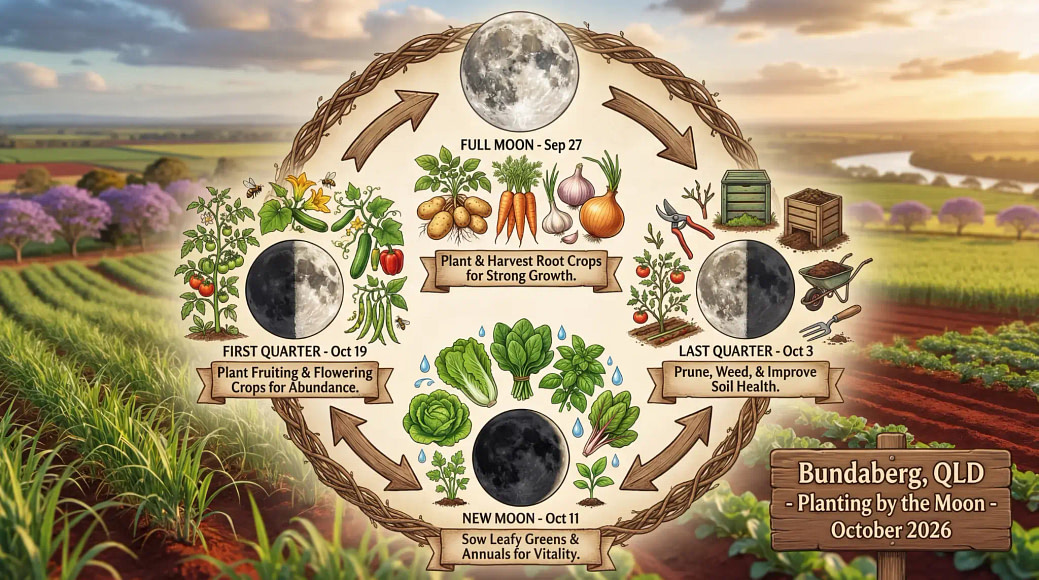
Planting by the Moon, October 2026 - A Bundaberg Gardener's Guide
Your complete lunar planting calendar for the month Bundaberg pivots into early summer, with the tropical planting list opening, fruit fly pressure peaking, and four moon phases to time your succession plantings.
October is when the Bundaberg garden starts looking and smelling like summer. Tomatoes from the September plantings are setting first fruit, beans are climbing fast, basil is in full leaf, and the days reach past 12 hours of daylight by the second week. It is also when the first storms of the wet season arrive, the fruit fly pressure climbs to its annual peak, and the temptation to plant late-summer crops crashes into the reality that any cool-season vegetable you put in now will struggle through November heat.
For lunar gardeners, October 2026 is a clean four-phase month. The new moon on Sunday 11 October at 1.50 am sets up a strong leafy and herb planting window for heat-tolerant varieties. The first quarter on Monday 19 October launches the second wave of fruiting crops and opens the door to the tropical planting list, including snake beans, okra, rosella, and ginger. The full moon on Monday 26 October closes the month with a harvest and storage focus.
If you set up your succession planting plan in September, October is when it pays off. If you did not, this month is when you start.
Why Plant by the Moon
Lunar gardening times your sowing, transplanting, and bed maintenance to the moon's four phases. Traditional growers across every farming culture observed that the same gravitational forces moving the tides also influence soil moisture and sap flow inside plants, and that lunar light affects germination and shoot growth. The waxing moon, from new to full, suits crops grown for above-ground harvest. The waning moon, from full to new, suits root crops, harvest, and maintenance.
Modern science is mixed on the magnitude of the effect, but the schedule has guided productive growers for centuries. In October, when the spring planting wave is still rolling and you need to choose between transplanting more tomatoes, sowing snake beans, or holding back for the new moon, the moon-based calendar gives you a useful structure.
October 2026 Moon Phases for Bundaberg
All times are local Brisbane time (AEST), which applies to Bundaberg.
Last Quarter on Saturday 3 October at 11.25 pm.
New Moon on Sunday 11 October at 1.50 am.
First Quarter on Monday 19 October at 2.12 am.
Full Moon on Monday 26 October at 2.11 pm.
The month opens in the late waning gibbous phase carrying through from the late September full moon, which means the first three days are naturally suited to root crops and bed preparation rather than fresh top growth.
1 to 3 October - Late Waning Gibbous
The first three days of October sit in the late waning gibbous, with energy moving downward into the root zone. A short window for direct-sown root crops before the maintenance week begins.
What to plant in this window:
- Beetroot. Heat-tolerant varieties hold best now. Direct sow.
- Carrots. The window is closing as the soil warms. Sow Manchester Table or Topweight before mid-October for reliable results.
- Radish. Three weeks from sowing to plate. Sow in semi-shade through October to prevent peppery, woody roots.
- Sweet potato slips. Plant into prepared, well-mulched beds.
- Salad onions and shallots. Continuous succession.
Bundy tip. October root crops perform best in beds with a thick mulch layer applied at sowing. The mulch keeps soil temperatures stable as the days warm, prevents the surface crusting that cuts off carrot germination, and reduces the watering frequency you will need through November.
4 to 10 October - Last Quarter to New Moon, the Maintenance Week
The waning crescent is the lowest fertility window of the lunar cycle. October's maintenance week is critical because the workload from the September plantings is starting to bite, and the next wave needs beds ready by the new moon.
What to do in this window:
- Bed preparation. Fork over fallow beds, work in 5 to 10 cm of finished compost, add aged manure, and apply a complete organic fertiliser.
- Fruit fly management. Check and re-bait traps. Drape exclusion netting over fruiting tomatoes, capsicum, eggplant, and stone fruit. Pick up any fallen fruit daily and bag for solarising or deep burial.
- Mulch every bed. The wet season is approaching, the heat is building, and exposed soil now will dry out and crack within a fortnight. Sugar cane mulch at 75 mm depth is the local standard.
- Tomato management. Side-shoot indeterminate varieties, tie up new growth, and apply a fortnightly seaweed and fish emulsion drench.
- Compost turning. Spring heaps started in August are now ready. Sift the compost onto your spring beds.
- Citrus. The first fruit set on the new flush is happening. Water deeply, mulch heavily, and apply a complete organic fertiliser if you missed the September feed.
- Storm preparation. Check that tall plants are staked, that trellises are secure, and that any shade cloth is firmly attached. The first thunderstorms of the wet season usually arrive in the second half of October.
Bundy tip. Hand pollinate cucurbits in the cool of early morning during October. Cucumber, zucchini, pumpkin, and squash all rely on bee activity, and the cool start to October sometimes leaves you waiting on bees that are not yet active. Pick a male flower, peel back the petals, and dab the pollen into the centre of a female flower. Yields can double with five minutes of effort.
11 to 18 October - New Moon to First Quarter, the Leafy and Herb Window
The new moon on 11 October launches the next waxing cycle. As lunar light returns and energy rises through plants, this is the prime window for heat-tolerant leafy greens, herbs, and the second wave of basil.
What to plant in this window:
- Lettuce (heat-tolerant only). Salinas, Mignonette, and the loose-leaf summer mixes. Cool-season cos and butterhead types will bolt fast now.
- Spring onions and chives. Continuous succession.
- Silverbeet and chard. Plant in semi-shade for best summer performance.
- Basil. The standout October herb. Sweet basil, Genovese, Thai, lemon basil, Greek bush basil. Plant successions every fortnight to keep continuous supply.
- Coriander. Plant in semi-shade only. Bolts fast in October heat. Vietnamese coriander is a heat-tolerant alternative for our climate.
- Parsley, dill, chervil, and chives.
- Tropical herbs. Vietnamese mint, lemongrass, kaffir lime, curry leaf, perilla, and shiso. October is the start of the tropical herb planting window in Bundaberg.
- Nasturtiums and marigolds.
- Sunflowers and zinnias. Plant in blocks for cut flowers and beneficial insect support.
Bundy tip. Lettuce planted at the new moon in October will bolt in seven to ten weeks rather than the twelve to fourteen you get in September. Switch to short-day, heat-tolerant varieties, plant in semi-shade or under a north-facing fruit tree, and harvest leaves rather than waiting for full hearts. Loose-leaf mixes outperform hearting types in October heat.
19 to 25 October - First Quarter to Full Moon, the Tropical Fruiting Window
The waxing moon between the first quarter and the full moon is the prime fruiting window. In October, this phase opens the tropical and heat-tolerant planting list that defines Bundaberg's true summer garden.
What to plant in this window:
- Snake beans. The standout October crop. Red Noodle, Yard Long, Asparagus Bean. Direct sow into warm soil, build a strong trellis at planting, and water deeply. The BOGI shop is the easiest local source for snake bean and tropical crop seed.
- Okra. Clemson Spineless and the red-podded varieties. Direct sow into warm soil. Tolerates heat and humidity better than almost any other crop.
- Rosella (Hibiscus sabdariffa). The classic Bundaberg jam crop. Direct sow now for harvest in late autumn.
- Ginger. Plant pre-sprouted rhizomes 5 cm deep, 25 cm apart, in part shade and rich, well-drained soil.
- Turmeric. Same approach as ginger.
- Lebanese cucumber, telegraph cucumber, and the burpless types. Direct sow.
- Zucchini, squash, and patty pan. One plant feeds a household.
- Pumpkin. Butternut, Jap, Queensland Blue, Kent. Direct sow into hills enriched with compost. Allow space.
- Watermelon, rockmelon, cantaloupe, and honeydew. Direct sow.
- Sweet corn. Continue succession plantings every three weeks.
- Tomatoes (succession). Plant a second wave for late summer and autumn fruit. Choose disease-resistant varieties.
- Capsicum and chilli (succession). The October planting will fruit through to autumn.
- Beans (climbing, bush, butter). Lazy Housewife, Purple King, Blue Lake.
- Sweet potato slips. Continuing.
- Sunflowers, cosmos, marigolds.
Bundy tip. Snake beans want a serious trellis from the start. Two metre tall, with hot wire or sturdy mesh, secured against summer storms. Plants will run three metres up and produce continuously for ten weeks if the trellis holds and the plants are picked daily. Build the structure before you sow the seed.
Full Moon, Monday 26 October - Harvest and Storm Watch
The full moon at the end of October is a textbook full moon. Use the day to harvest crops you intend to store, finalise November bed preparation, and check that everything is staked and netted before the wet season storms hit. Traditional lunar wisdom says to avoid major above-ground sowing on the day of the full moon.
By late October the wet season is on the doorstep. If you have not prepared, today is the day. Check storm tie-downs, drainage, mulch coverage, and trellis security.
Working With Bundaberg's October Climate
October is a warming month with the first signs of the wet season returning.
Daytime maximums average 27°C in the first week, climbing to 29°C by the final week.
Overnight minimums average 17 to 19°C.
Rainfall averages around 50 mm for the month, though this is often delivered in one or two heavy thunderstorms rather than evenly. The first wet season storms usually arrive in the second half of October.
Humidity climbs from around 60 per cent at the start of the month to 65 per cent by 31 October.
Daylight grows from 12 hours 10 minutes at the start of the month to 12 hours 50 minutes by 31 October.
Soil temperature in raised beds runs at 22 to 25°C through October. The full warm-season planting list is open, and soil is no longer a limiting factor.
The challenge in October is moisture management. Long dry stretches between storms mean irrigation is critical, but the first big storm of the season can dump 50 mm in an afternoon and waterlog poorly drained beds. Raised beds and heavy mulch are your friends.
What to Harvest in October
October is the start of the early summer harvest, with strawberries at their absolute peak and the first of the warm-season crops coming in.
Strawberries (peak), the last of the broccoli and cauliflower, late cabbage, kale, kohlrabi, lettuce, silverbeet, spinach, beetroot, carrots, salad onions, herbs, the last of the citrus tail, mulberries (peak), the first new season pawpaw, early avocado (Hass and Reed), the first beans from late August plantings, asparagus from established crowns, peas (last), broad beans (last), and macadamias.
Strawberries hit peak production in early to mid-October and decline through November as the heat builds. Pick daily to keep the plants productive and to stay ahead of the birds.
A Note on Lunar Gardening
The honest version of lunar gardening is that it sits between traditional knowledge and modern science. Gravity moves water, lunar light affects germination, and the schedule aligns your work with cycles your plants are already responding to. The size of the effect is small compared to soil quality, variety choice, and irrigation, but small effects compound across a season.
In October, with the planting list at its longest and the workload heaviest, the lunar calendar gives you a way to pace the work. Plant your leafy crops the week of the new moon, plant your fruiting crops the week of the first quarter, and use the maintenance week before the new moon for bed preparation. The calendar writes itself, and that is half the battle.
Quick Reference, October 2026
- 1 to 3 October (late waning gibbous). Plant root crops, sweet potato slips.
- 4 to 10 October (last quarter to new moon). Maintenance week. Bed prep, fruit fly traps and netting, mulch every bed, storm preparation.
- 11 to 18 October (new moon to first quarter). Plant heat-tolerant leafy crops, basil successions, tropical herbs.
- 19 to 25 October (first quarter to full moon). The tropical fruiting wave. Snake beans, okra, rosella, ginger, turmeric, melons, cucurbits, succession tomatoes and beans.
- 26 October (full moon). Harvest, finalise storm preparation.
Looking Ahead to November
November is when Bundaberg slides into proper summer. The new moon falls on Monday, 9 November and the full moon on Wednesday, 25 November. Wet season storms become regular, the heat builds toward December, and the planting list narrows to truly heat-tolerant tropical and subtropical crops.
Order seed for any final summer plantings, and start thinking about shade and water. Our November planting guide will be live by 1 November.
Frequently Asked Questions
When should I plant snake beans in Bundaberg?
Snake beans need warm soil consistently above 22°C and warm nights to thrive. Mid-October is the ideal start of the planting window in Bundaberg, running through to early February. Direct sow into a prepared bed with a tall, sturdy trellis already in place.
Is October too late for tomatoes in Bundaberg?
Not at all. October is an excellent month to plant a second succession wave of tomatoes for late summer and autumn fruit. The October crop matures through January and February, often outlasting the September plantings as those exhaust themselves. Choose disease-resistant cultivars and stake firmly against summer storms.
How do I control fruit fly in a Bundaberg garden?
Combined trap and net management is the most reliable approach. Hang at least one fruit fly trap per ten metres of garden from early September. Drape exclusion netting over tomatoes, capsicum, eggplant, and stone fruit from first flower. Pick up any fallen fruit daily and bag for solarising. The combined approach cuts fruit fly damage by 80 to 95 per cent.
Can I plant lettuce in October in Bundaberg?
Yes, but switch to heat-tolerant varieties. Salinas, Mignonette, and loose-leaf summer mixes hold up best. Plant in semi-shade or under the dappled cover of a north-facing fruit tree, harvest leaves rather than waiting for full hearts, and accept that the cropping window is shorter than spring or autumn.
Where do you source the moon phase data?
All times are local Brisbane time (AEST), sourced from timeanddate.com, which is the closest reference city for Bundaberg.
Bundaberg Organic Gardeners Inc has been growing organic food in the Wide Bay since 1991. If you found this guide useful, join us to get monthly meetings, members-only resources, and access to our seed bank, and browse our shop for seasonal seeds, mulch, and member resources. Our next workshop and field day dates are on the activities and events page.
Moon phase data sourced from timeanddate.com for Brisbane, Queensland (the nearest reference city to Bundaberg).