

Select photo for information from the National Trust Queensland
A Fascinating Journey into the World of Bees
Our June 2024 meeting featured a fascinating presentation by Hayley Martell from the Bundaberg Beekeepers Association, joined by fellow beekeeper Bec. Together, they gave members an engaging introduction to the remarkable world of honey bees, explaining how a hive functions and answering many interesting questions from the audience.
Meet the Honey Bee Family
A European honey bee hive is home to three different types of bees, each with a unique role.
The Queen
The queen is the only fertile female in the hive and her primary role is laying eggs. During the busy season, she can lay between 1,500 and 2,000 eggs every day. A queen may live for up to five years, although commercial beekeepers often replace queens every year or two to maintain a productive colony.
From the time she hatches as a larva, the queen is fed royal jelly, a highly nutritious substance produced by young worker bees.
Worker Bees
Worker bees are female and make up the vast majority of the colony. They perform almost every task required to keep the hive alive, including:
- Collecting nectar, pollen and water
- Producing honey and beeswax
- Feeding the young
- Building and repairing honeycomb
- Cleaning the hive
- Guarding the entrance
- Ventilating the hive by fanning their wings
During the busy summer months, a worker bee lives for around six weeks. Although each worker produces only about one teaspoon of honey during her lifetime, together they create the remarkable stores of honey that sustain the colony.
Drone Bees
Drone bees are the males of the colony. Unlike worker bees, drones do not collect nectar or pollen and do not help maintain the hive. Their sole purpose is to mate with a queen from another colony. After mating, the drone dies. As food becomes scarce, worker bees often force the drones out of the hive to conserve precious resources.
Life cycle of a bee
Queen lays eggs in wax cells - Worker feeds hatched larva - Larva reaches full growth - Worker seals cell - Larva becomes a pupa - Adult bee leaves the cell.

Select photo for more information from BuzzAboutBees.net
Bee hives
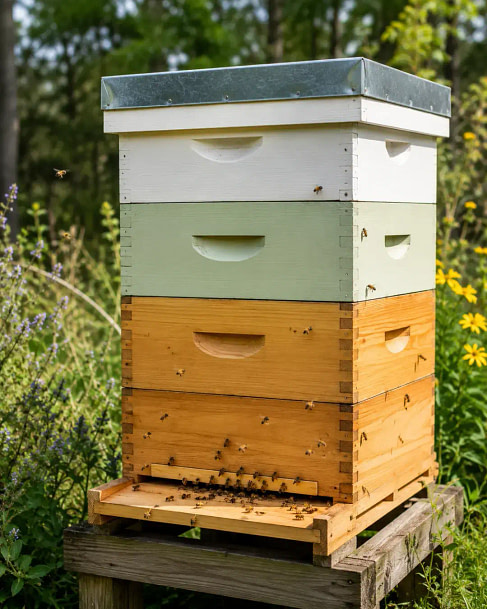
Beehives can come in lots of different styles from flow hives to old fashioned style hives. Hives contain a baseboard, box and lid. Regardless of the type of hive that you have you need to inspect it at least 4 times a year and it is important to never drain a hive of honey or the bees will die.
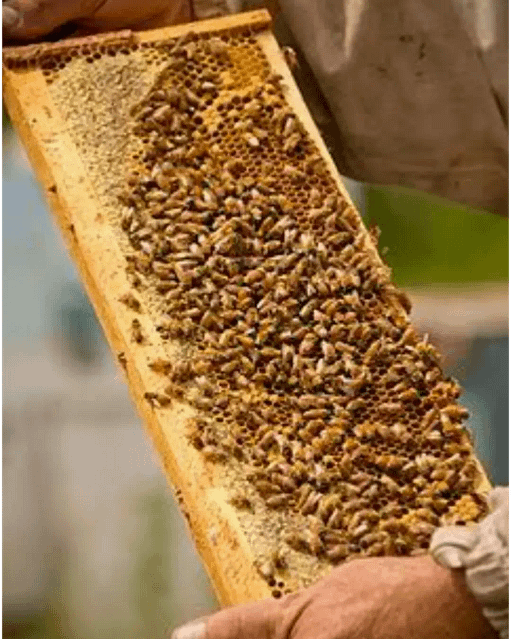
Within a hive is a brood box. On a frame in the brood box, we can usually see drone brood, worker brood, empty cells, honey and pollen. Pollen gets carried about on the back legs of the worker bees. Sometimes bees create hives in inconvenient places for people. Sometimes they build hives in house walls and caravans. These can be quite large as there are about 50,000 bees in a hive which can cause a lot of damage. When relocating bees, they use a bee vacuum. They have to hope that they get the queen and then the bees will stay together; if not, they have to go back for the queen.
The venom is then collected and sells for about $300 per millilitre. It takes thousands of bees to make this venom.
- Question: Would bees move in because a hive is close to the house?
- Answer: They may just find a hole in a wall and just move in.
- Question: If the queen lives for five years, then what about the drones?
- Answer: Drones come from other hives to mate with the queen. When the hives get too big or there is not enough food within a 5-17km radius or the queen thinks she is about to be assassinated, she will take about 80% of her hive and leave.
- Question: What is Royal Jelly?
- Answer: A nectar and pollen mix.
- Question: How do they know if they want drones or worker bees?
- Answer: Drones get laid in drone cells. Worker bees tell the queen what to lay. There will only be one queen in a hive and they will kill rival queens.
- Question: Is it true that a bee stings and dies?
- Answer: The sting has a barb on it so they can’t pull it out and that is why they die. A dead bee can still sting you.
- Question: How do they say it is one type of honey?
- Answer: They now have varieties of macadamia that flower between June and September. Honey is tested and it has to be 85% of that type of honey to be classed as that kind of honey. Bees may feed elsewhere as the European bees can travel 7-10km, whereas native bees travel in a 500m radius. Plants have different sugar contents so you can tell what plants they came from when tested.
Here is a great book in our library, available to members, where you can discover more about the wonder of bees!
The Mind of a Bee – Lars Chittka - A rich and surprising exploration of the intelligence of bees. Most of us are aware of the hive mind - the power of bees as an amazing collective. But do we know how uniquely intelligent bees are as individuals?
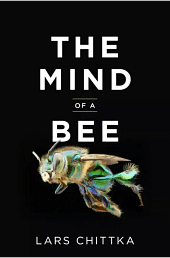
In The Mind of a Bee, Lars Chittka draws from decades of research, including his own pioneering work, to argue that bees have remarkable cognitive abilities. He shows that they are profoundly smart, have distinct personalities, can recognise flowers and human faces, exhibit basic emotions, count, use simple tools, solve problems, and learn by observing others. They may even possess consciousness.
Chittka also examines the psychological differences between bees and the ethical dilemmas that arise in conservation and laboratory settings because bees feel and think. Throughout, he touches on the fascinating history behind the study of bee behaviour. Exploring an insect whose sensory experiences rival those of humans, The Mind of a Bee reveals the singular abilities of some of the world's most incredible creatures.
Select photo for more information from www.australianenvironmentaleducation.com.au