
Planting by the Moon, July 2026 - A Bundaberg Gardener's Guide
Your complete lunar planting calendar for the heart of Bundaberg's winter, including seed potato timing, the full citrus glut, and four moon phases that line up beautifully with the cool dry month.
July is the coldest month of the Bundaberg year, but you would not know it from the produce coming out of an organic garden. Citrus is at full swing, brassicas planted in May and June are heading and curding, and the peas you tucked in around the autumn equinox are finally pushing pods. This is the month when winter gardening rewards the people who turned up in May.
It is also the prime potato planting window. If you only grow potatoes once a year, do it in July. The cool soil and dry weather mean low disease pressure, and your tubers will be ready to harvest as the spring tomatoes are going in.
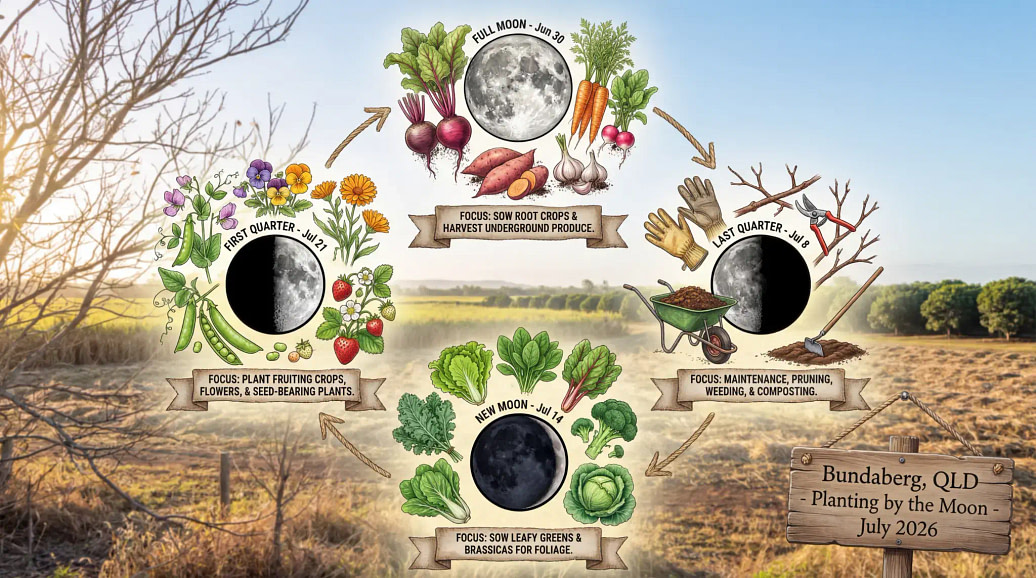
For lunar gardeners, July 2026 delivers a tidy four-phase month with no special events to disrupt the rhythm. The new moon on Tuesday 14 July and the full moon on Thursday 30 July bookend a cycle that fits neatly within the calendar month. Here is how to use it.
Why Plant by the Moon
Lunar gardening is the practice of timing your sowing, transplanting, and maintenance work to the four phases of the moon. Traditional growers across every farming culture observed that the same gravitational forces that move ocean tides also influence soil moisture and sap flow inside plants, and that lunar light affects germination and shoot growth. The waxing moon, from new to full, suits crops grown for above-ground harvest. The waning moon, from full to new, suits root crops, harvest, and maintenance.
Whether the effect is large enough to change yields is contested in the scientific literature, and any honest gardener will tell you the schedule alone will not save you from poor soil or the wrong variety choice. What it will do is give you a structure that has guided productive gardeners for generations, and force you outside on a regular schedule even when the mornings are 9°C and you would rather be inside with the kettle on.
July 2026 Moon Phases for Bundaberg
All times are local Brisbane time (AEST), which applies to Bundaberg.=
Last Quarter on Wednesday 8 July at 5.29 am.
New Moon on Tuesday 14 July at 7.43 pm.
First Quarter on Tuesday 21 July at 9.05 pm.
Full Moon on Thursday 30 July at 12.35 am.
The month opens in the late waning phase carrying through from the June Micro Full Moon, which means the first week is naturally suited to root crops and storage harvest.
1 to 7 July - Waning Gibbous to Last Quarter, Roots and Storage.
The first week of July sits in the waning gibbous, with energy moving downward into the rootzone. It is a productive window for direct sowing root crops and for harvesting anything you intend to store.
What to plant in this window:
Bundy tip. The cool, dry July soil is perfect for direct sowing root crops, but it can crust badly after watering. Cover newly sown rows with a thin layer of seed-raising mix or fine compost rather than your normal garden soil. The lighter texture lets seedlings break through cleanly, even after a heavy watering.
8 to 13 July - Last Quarter to New Moon, the Maintenance Week
The waning crescent is the lowest fertility window of the lunar cycle. Use this week for the jobs that keep the garden ticking along but do not involve fresh planting. July's cool dry weather makes this the most pleasant maintenance week of the year.
What to do in this window:
- Citrus harvest at scale. Mandarins are at peak, navels are pushing, valencias are filling, and lemons, limes, and grapefruit are running. Pick by hand at the stem, store at room temperature, and donate or preserve the surplus.
- Pruning. Cut deciduous fruit trees (peaches, nectarines, plums, persimmons) while they are still dormant. Avoid pruning subtropical fruits like avocado, mango, lychee, and longan until late winter or early spring. Trim back overgrown perennial herbs by a third.
- Bed prep. Fork over fallow beds, work in aged manure or compost, and let the worms work the amendments down through the soil ahead of August planting.
- Trellis building. Build or repair pea, bean, and cucumber trellises now while the weather is comfortable. Spring puts pressure on the time available.
- Pest patrol. Aphids are the main winter pest in Bundaberg. Check brassicas weekly. Squash colonies by hand, hose off heavier infestations early in the morning, or apply a half-strength soap and water solution.
Bundy tip. July is the last sensible month to take cuttings of woody perennial herbs (rosemary, sage, oregano, thyme) before the spring flush. Take 10 cm tip cuttings, strip the lower leaves, dip in honey or willow water, and pot into a 50/50 mix of seed-raising mix and coarse sand. Keep them in dappled shade and water sparingly.
14 to 20 July - New Moon to First Quarter, the Leafy Window
The new moon on 14 July marks the start of the next waxing cycle. As lunar light returns and energy rises through plants, this is the prime window for leafy greens, brassicas, and any crop that produces above ground.
What to plant in this window:
- Brassicas. Broccoli, cauliflower, cabbage, kale, kohlrabi, Asian greens. Late July plantings will mature through September into October.
- Lettuce. All cool-season varieties. Cos, butterhead, oak leaf, mignonette. Sow direct or transplant strong seedlings.
- Silverbeet and spinach. Both crop heavily through winter and into early spring.
- Spring onions, salad onions, and chives. Continuous succession.
- Coriander, parsley, dill, chervil, and rocket. The cool window keeps coriander from bolting for at least eight weeks.
- Sweet peas, calendula, stocks, pansies, violas, primulas, and snapdragons. Winter colour into spring.
Bundy tip. Lettuce planted in July often sulks for the first fortnight. The slow growth is normal. Resist the urge to push it with high nitrogen feeds, which produce soft growth that aphids will find. A weekly seaweed drench at half strength is enough to maintain steady growth, and the slower pace produces denser, sweeter heads.
21 to 29 July - First Quarter to Full Moon, the Fruiting Window
The waxing moon between the first quarter and the full moon is the traditional window for crops that bear fruit, pods, or seed. July fruiting plantings are still conservative because the soil is cool, but a few crops thrive and the late-month window starts looking ahead to spring.
What to plant in this window:
- Garden peas, snow peas, sugar snap peas. Massey, Greenfeast, Telephone, Oregon Sugarpod, Sugar Snap. Trellis early, mulch heavily.
- Broad beans. Last reliable window. Coles Dwarf or Aquadulce.
- Asparagus crowns. The end of the textbook planting window. Plant in a permanent corner because the patch produces for fifteen to twenty years.
- Tomato seedlings (sheltered position only). If you have a north-facing wall or a glasshouse, you can start tomato seedlings now for transplanting in late August. Use small-fruited varieties like Tommy Toe, Tigerella, or Black Cherry.
- Capsicum and chilli (warm position only). Start seedlings indoors or in a heated propagation tray for transplanting in late August or early September.
- Globe artichokes, rhubarb crowns, and strawberry runners (final window).
Bundy tip. If you are starting tomato or capsicum seedlings in mid to late July, use a seedling heat mat or place the trays on top of a chest freezer or fridge where the warm air rises. The seed needs soil temperature above 18°C to germinate reliably, and Bundaberg July ambient temps are well below that.
Full Moon, Thursday 30 July - Storage and Harvest
The full moon at the end of July is a textbook full moon, with no special characteristics. Use the day for harvesting crops you intend to store, finishing bed preparation, and walking the garden to assess what is working ahead of August's spring planting wave. Avoid major above-ground sowing on the day itself.
Working With Bundaberg's July Climate
July delivers the coldest mornings of the Bundaberg year and the driest weather.
Daytime maximums average 22°C, holding steady through the month.
Overnight minimums average 9 to 11°C in town and 6 to 8°C out toward Childers, Gin Gin, and the Sharon district. Some mornings record minimums in the low 5s on clear, still nights.
Rainfall averages around 40 mm for the month, the driest of the year.
Humidity sits around 55 per cent.
Daylight starts to lengthen after the solstice, moving from 10 hours 28 minutes at the start of the month to 10 hours 50 minutes by 31 July.
Frost in central Bundaberg is rare but possible during clear, still nights. Properties on the ranges around Childers and the Mount Perry road can record several frosts. Drape frost cloth or old sheets over tender seedlings overnight when the forecast minimum drops below 4°C in elevated locations.
Soil temperature in raised beds averages 14 to 16°C through July. This is below the germination threshold for warm-season crops like beans, corn, cucurbits, and most fruiting vegetables. Plan around the soil rather than the air.
What to Harvest in July
July is Bundaberg's most generous fruit harvest month and a strong vegetable month from autumn plantings.
Mandarins (Imperial, Hickson, Murcott, Daisy), navel oranges, valencia oranges, lemons, limes, grapefruit, cumquats, pomelo, broccoli, cauliflower, cabbage, kale, pak choy, bok choy, lettuce, silverbeet, spinach, peas (early plantings), beetroot, carrots, salad onions, herbs, late macadamias, persimmons (last fruit on the tree), pumpkins from storage, and the last of the autumn-stored sweet potato.
If your citrus tree is overloaded, prop the heavy branches with stakes, pick early fruit to lighten the load, and water deeply twice a week. A stressed tree can drop fruit and weaken the next season's flowering.
A Note on Lunar Gardening
The honest assessment of lunar gardening is that it sits somewhere between traditional wisdom and modern science. The gravitational pull of the moon does measurably influence soil water, and lunar light has demonstrable effects on the germination of certain species. Whether the effect is large enough to change a backyard yield is contested.
What is not contested is the value of a schedule. In July, when the days are short, the mornings are cold, and the temptation to skip the garden is strong, having a moon-based calendar to follow gets you out the back door with a trowel in hand. That alone is worth more than any theoretical yield boost.
Quick Reference, July 2026
1 to 7 July (waning gibbous to last quarter). Plant potatoes, root crops, alliums. Cool soil suits all of them.
8 to 13 July (last quarter to new moon). Maintenance week. Citrus harvest, deciduous fruit pruning, trellis building.
14 to 20 July (new moon to first quarter). Plant brassicas, leafy greens, herbs. Last big winter leafy window.
21 to 29 July (first quarter to full moon). Plant peas, broad beans, asparagus crowns, start tomato seedlings indoors.
30 July (full moon). Harvest, plan, finish bed prep for August.
Looking Ahead to August
August is when Bundaberg gardening starts pivoting toward spring. The new moon falls on Thursday 13 August and the full moon on Friday 28 August. Soil temperatures begin to climb, and from late August you can plant tomatoes, capsicums, beans, and the first of the spring leafy crops.
Start preparing your spring beds now. Add compost, check pH, and order your warm-season seed before the September rush. Our August planting guide will be live by 1 August.
Frequently Asked Questions
When should I plant potatoes in Bundaberg?
July is the textbook potato planting month for Bundaberg. The cool dry weather minimises disease pressure, and the soil temperature is just right for sprout development without rotting. Late June and early August also work, but July is the standout window.
What can I plant in Bundaberg in July?
The full winter list still applies. Potatoes, brassicas (broccoli, cauliflower, cabbage, kale), Asian greens, lettuce, silverbeet, spinach, peas, broad beans, onions, leeks, salad onions, beetroot, carrots, radish, asparagus crowns, and herbs. Mid-July is also a good time to start tomato and capsicum seedlings indoors for spring transplanting.
Does Bundaberg get frost in July?
Central Bundaberg occasionally records light frosts on clear, still nights, but most years the town stays frost-free. Properties on the elevated country around Childers, Gin Gin, and the Mount Perry road record several light frosts each July. Cover tender seedlings overnight when minimums are forecast below 4°C in those locations.
Can I plant tomatoes in July in Bundaberg?
Not directly outside. The soil is too cold for reliable germination and the seedlings will sulk. You can start tomato seedlings indoors or in a glasshouse from mid-July, ready to transplant in late August or early September when the soil reaches 18°C.
Where do you source the moon phase data?
All times are local Brisbane time (AEST), sourced from timeanddate.com, which is the closest reference city for Bundaberg.
Bundaberg Organic Gardeners Inc has been growing organic food in the Wide Bay since 1991. If you found this guide useful, join us to get monthly meetings, members-only resources, and access to our seed bank, and browse our shop for seasonal seeds, mulch, and member resources. Our next workshop and field day dates are on the activities and events page.
Moon phase data sourced from timeanddate.com for Brisbane, Queensland (the nearest reference city to Bundaberg).